


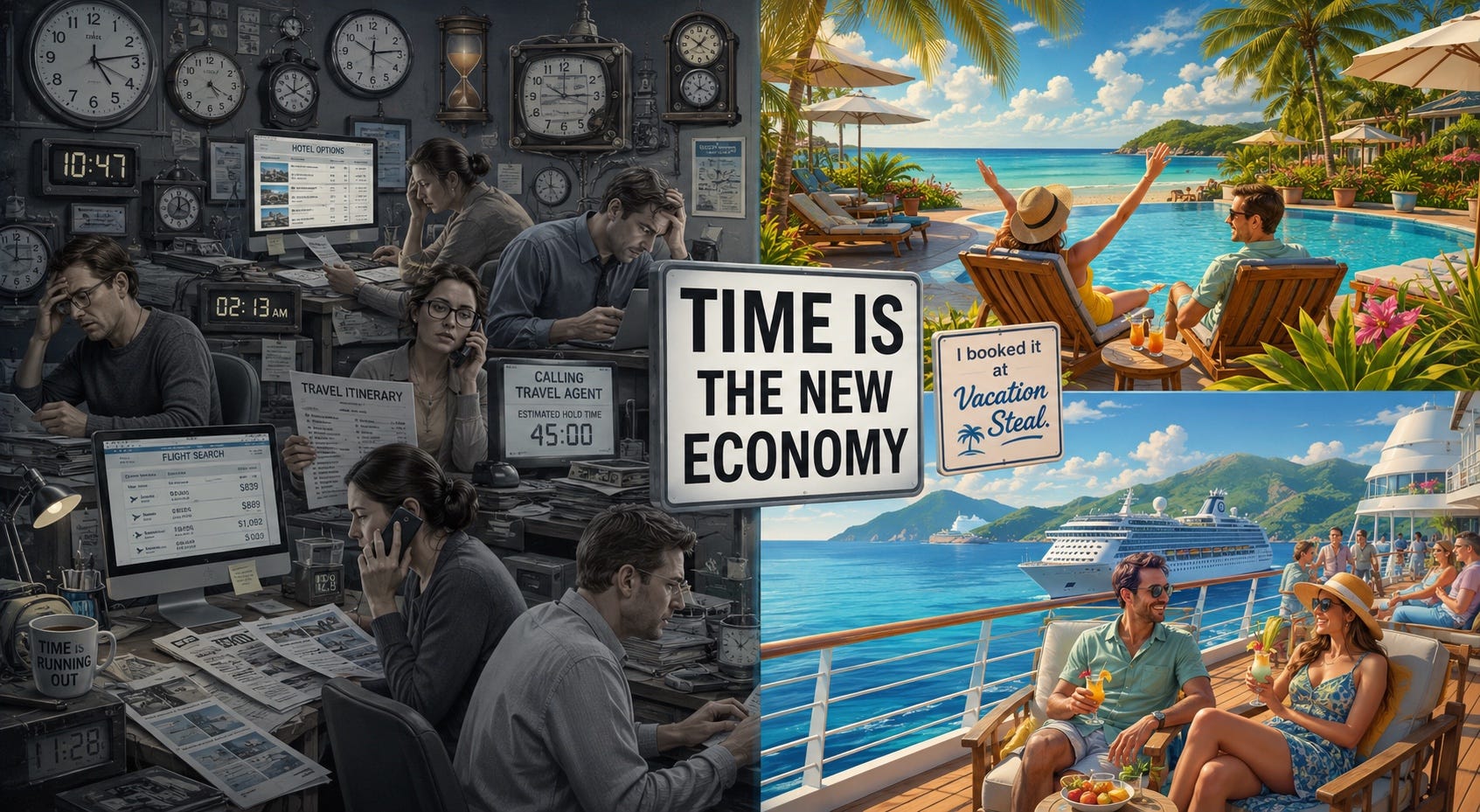
Time Is the New Economy is an ongoing editorial series exploring how technology, artificial intelligence, remote work, and changing consumer behavior are redefining the value of time—and what that means for business, travel, and everyday life.
“I just need to book a vacation.”
It sounds simple enough.
Yet for many travelers, that simple decision turns into hours of comparing websites, reading reviews, watching YouTube videos, checking social media, experimenting with AI travel planners, and wondering whether one more search might uncover a better deal.
By the time they finally click Book Now, they’ve invested far more than money.
They’ve invested time.
This isn’t just a travel problem.
It’s an economic one.
A New Kind of Economy
For generations, economic success has been measured in familiar ways—productivity, wages, profits, GDP, and consumer spending. Those measures remain important, but they don’t fully explain how our lives are changing.
Technology has transformed the world at breathtaking speed. The Internet connected billions of people. Smartphones placed that connection in our pockets. Artificial intelligence is rapidly becoming our researcher, assistant, translator, planner, and creative partner. Remote work has untethered millions of professionals from a single office and, increasingly, a single location.
These innovations have created opportunities previous generations could scarcely imagine.
They’ve also created something else.
Complexity.
Every new technology, platform, service, and subscription promises to save us time. Yet somehow many people feel busier than ever.
Why?
Because every new opportunity creates another decision.
The Hidden Cost of Choice
Economists have a term for what we give up whenever we make a decision.
Opportunity cost.
Traditionally, opportunity cost has been viewed in financial terms. Spend money here and you can’t spend it somewhere else.
Today, the greater cost is often measured in time.
Every hour spent researching a purchase is an hour not spent with family.
Every evening comparing travel options is an evening not spent planning the vacation experiences you’ll actually remember.
Every unnecessary decision quietly consumes something that cannot be replaced.
Money can usually be earned again.
Time cannot.
Technology Solves Problems—Then Creates New Ones
Technology has dramatically reduced the cost of finding information.
It has not reduced the cost of deciding what to do with it.
Think about the choices we face every day.
Which AI assistant should I use?
Which streaming service is worth another subscription?
Should I work from home, from the office, or while traveling?
Which airline, cruise line, hotel, or booking website offers the best value?
Information has become abundant.
Attention has not.
Time has not.
As technology expands our options, it also increases the effort required to evaluate them.
The friction hasn’t disappeared.
It has simply moved.
Travel Is Where the Time Economy Becomes Personal
Few industries illustrate this better than travel.
A vacation is supposed to be relaxing.
Planning one often feels like a second job.
Today’s traveler may compare airline websites, hotel brands, cruise lines, vacation rentals, online travel agencies, review sites, travel blogs, AI recommendations, YouTube videos, loyalty programs, and dozens of browser tabs before making a single reservation.
The irony is obvious.
Technology has made booking travel easier than ever.
It has also made choosing how to book remarkably more complicated.
The hidden cost isn’t simply the price of the trip.
It’s the hours spent searching, comparing, verifying, and second-guessing.
That’s time you’ll never get back.
The Economy Is Changing
Businesses have always competed on price.
They’ve competed on quality.
They’ve competed on service.
Increasingly, they’ll compete on something else.
Their ability to reduce friction.
The businesses that succeed over the next decade won’t simply help customers spend less money.
They’ll help customers spend less time making decisions.
That’s the central idea behind this series.
Over the coming weeks we’ll explore how artificial intelligence, technology, remote work, and changing consumer behavior are reshaping modern life. We’ll examine why booking travel has become so complicated, why digital nomads are redefining work, why long-term cruising is emerging as a lifestyle, and why trusted recommendations may become more valuable than endless comparisons.
Time is becoming the world’s most precious resource.
The companies—and the people—that understand this shift will have an enormous advantage.
Because once time is spent, there are no refunds.
No exchanges.
No do-overs.
Money can usually be earned again.
Time cannot.
Recommended Reading
Harvard Business Review — Death by Information Overload
Timeconomy: Time Is the New Currency (book by Gary Vaynerchuk and others discussing time as a modern economic resource and competitive advantage.)
Next in the Series
Technology Is Solving Old Problems—and Creating New Ones
Technology has made life faster and more connected while introducing new layers of complexity. We’ll examine how AI, smartphones, and the Internet have expanded our opportunities, increased decision fatigue, and reshaped how we work, travel, and make decisions.